Some defeats arrive just when you thought you had made it. They aren’t necessarily the most important ones, but they often leave you with something to think about.
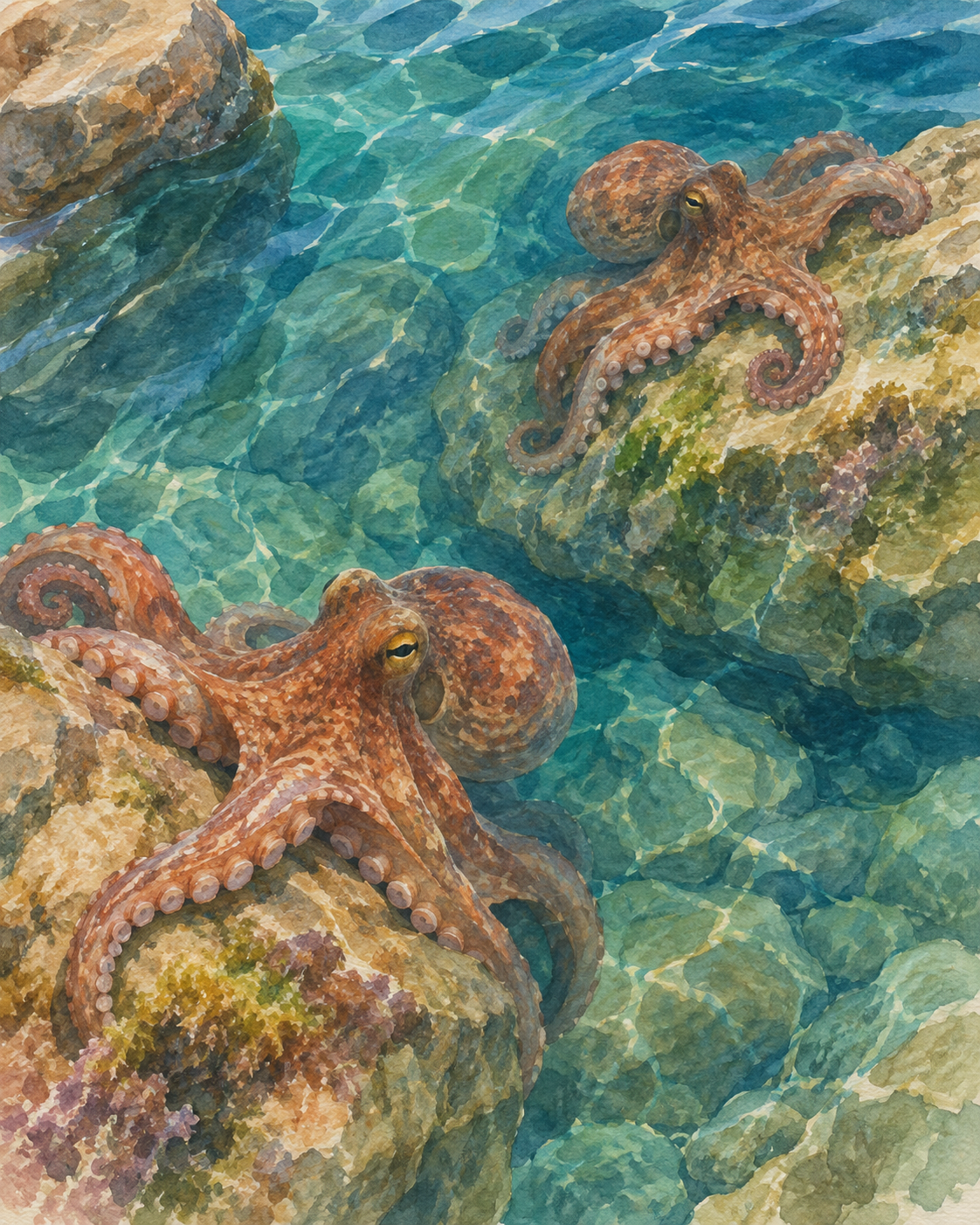
The other day I went fishing, and something curious happened. I managed to hook two enormous octopuses. Not at the same time, of course, but during the same outing. Two encounters that could have turned into two fine catches, yet ended in exactly the same way.
I felt them on the rod and even managed to see them. They were big, really big. The trouble came just when the hardest part seemed to be behind me: as I brought them in, both reached the rocks and clung to them.
From that moment on, I couldn’t bring either of them in.
Two octopuses, two missed opportunities, and a thought that seems almost paradoxical in hindsight: I had managed to hook them, but not to get them out of the water. I had overcome the first part of the challenge without completing the last.
It may sound like a trivial incident. After all, anyone who fishes knows that a catch can get away and that not every outing ends as we would like. But sometimes small things hold lessons that reach beyond what actually happened.
Fishing, for instance, is one of those activities that constantly brings us up against something we cannot fully control. We can choose our equipment, study the seabed, learn to use bait and refine our technique. We can prepare carefully and do everything we think is right. But in the end, on the other side of the line, there is a living creature following rules entirely different from ours.
And that changes everything.
We think in terms of catching, retrieving and results. An octopus knows nothing of our wish to bring it ashore. It knows its surroundings, the rocks, the crevices, how to move and how to grip a surface. What we see as an obstacle is simply part of the world it lives in.
When you think about it, there is something extraordinary about an octopus’s ability to cling to rocks. Its suckers do more than stick to surfaces: they are sensory organs too. They let it explore its surroundings through contact, combining touch with chemical information. In a sense, an octopus can even taste what it touches.
Seen that way, the scene takes on a different perspective. On one side, a rod, a reel and a thin line trying to pull something towards the surface. On the other, an animal perfectly adapted to an environment we can only observe from the outside.
It is hardly surprising, then, that once an octopus reaches the rocks, bringing it in can become extremely difficult.
Beyond the nature of the animal, though, this incident gives me a way to talk about another aspect of fishing: our tendency to hurry just as we get close to a result.
When something is almost within reach, patience can become harder to find. The distance between us and our goal is tiny, and that is precisely what can tempt us to close it too quickly.
This is a pattern that reaches far beyond fishing.
How often in life, after giving something time and care, do we risk undoing it all in the final stages? How often do we mistake being close to a result for being certain we have already achieved it?
Fishing reminds us, in a very practical way, that getting close does not mean getting there.
This is where equipment comes in — or rather, the way we choose to use it.
A fishing rod is not a crane. It is not designed to lift the full weight of a catch out of the water regardless of the circumstances, especially when it is still far away or resisting. The rod’s flexibility distributes the strain, while the reel’s drag allows line to run out when the tension becomes too great.
Lifting the rod tip too high in an attempt to force a catch in can put dangerous strain on the upper section. It is an easy mistake to make when we think strength is the way to control everything, whereas control depends above all on feel.
With a fish that is fighting, you often need to learn to follow its movements, retrieve line at the right moments and let the equipment do its job, without needlessly prolonging the fight. It is a balance of pressure and patience in which strength alone guarantees nothing.
With an octopus, it is different. It is less about waiting for it to tire and more about preventing it, as far as possible, from reaching somewhere it can grip firmly while you bring it in.
Because once it has a hold on a rock, the situation changes.
And then there is the landing net.
A simple tool, sometimes treated as less important than the rod, reel or bait. Yet it can become essential at the very moment when a catch seems all but secured.
A landing net suited to the place you are fishing allows you to bring in a catch without making the rod and line bear its entire weight. When fishing from rocks, though, you need to think ahead: the height above the water, the length of the handle and whether you can reach the catch safely can make a great difference.
I don’t know whether a landing net would have changed the outcome of those two attempts. It would be too easy to tell the story by putting all the blame on a missing tool or a single wrong movement.
We cannot always pinpoint the moment when something took a different turn from the one we had hoped for.
But we can try to understand what the experience has to tell us.
Perhaps this is one of fishing’s most important lessons: learning to distinguish between what depends on us and what we cannot command.
We can be more attentive, better prepared, more patient. We can improve our technique and learn from mistakes. But we also have to accept that the sea owes us nothing.
It doesn’t owe us a catch simply because we waited. It doesn’t owe us a result because we bought the right equipment. And it doesn’t necessarily owe us an explanation when something goes wrong.
Perhaps this is a kind of humility we need to practise more often away from the water too.
We live in a world that constantly urges us to control, predict and measure everything. We like to think every result follows directly from our effort, as though life were an equation in which entering the right elements would be enough to get what we want.
But it doesn’t always work that way.
Sometimes we do everything we can and things still take another course. At other times, a small mistake is exactly what reminds us that we still have something to learn.
My two octopuses stayed on the rocks.
I don’t know whether I’ll manage to bring in a similar catch next time, or whether having the landing net ready will be enough. All I know is that this experience offers more than one reason to approach those final moments differently.
Perhaps learning also means this: finding value in something that didn’t go the way we wanted, without having to pretend it was a victory.
Because not every experience has to end with a result to take home.
Sometimes what stays with us isn’t the catch.
It is what we learned while trying to land it.